Citrus Leaf Yellowing Checklist: 8 Causes and What to Do Next
Citrus Leaf Yellowing Checklist: 8 Causes and What to Do Next
A lemon tree can look perfectly healthy on Sunday and, by Thursday, be wearing a skirt of yellow leaves. The first instinct is usually to reach for fertiliser. That is often the wrong move, because yellowing is a symptom with a dozen possible causes, and feeding a waterlogged or root-damaged tree just adds another problem to the list.
What follows is the checklist worth running when a tree in the grove or on the terrace starts to lose its colour. Work through it in order. In most cases the pattern of the yellowing — which leaves, where on the tree, how fast it moved — narrows the cause to two or three suspects before you have touched a bag of fertiliser.
Read the Pattern Before You Do Anything
A single yellow leaf near the base of the canopy is usually nothing to worry about. A whole quadrant going pale in a week is a different conversation. Spend ten minutes looking before you test anything.
- Which leaves? Older leaves low down and inside the canopy point toward nitrogen, magnesium or wet roots. The newest flush at the tips points toward iron, zinc or cold damage.
- Veins or no veins? Yellow between green veins is the signature of iron, magnesium and manganese. A leaf that fades evenly has usually run short of nitrogen.
- One branch or the whole tree? Localised yellowing suggests a damaged root, a girdled branch, a pest colony or physical injury. Even yellowing across the canopy suggests something the entire root system is experiencing.
- How fast? Collapse within days means water, cold or roots. A slow fade over weeks means nutrition or a chronic soil problem.
- What else is there? Sticky leaves, a black sooty coating, curling edges, mottling, unusually small leaves, leaf drop.
Take photos and keep a few notes. Citrus problems unfold over weeks, and you will want the comparison later. A leaf that was pale last month but has since greened at the veins tells a very different story from one that has gone from green to yellow to crisp in ten days.
Water: Too Much, Too Little, and Everything in Between
More citrus trees are lost to wet roots than to drought. Roots need oxygen as much as moisture; sit them in saturated soil for a few days and the fine feeder roots begin to die. A tree cannot take up water through drowned roots, so it responds the way a thirsty tree does — yellowing, then leaf drop — which is exactly why overwatering gets misread and topped up with more water.
Check properly rather than guessing. Push a finger or a small trowel down five to ten centimetres in three places around the drip line, not against the trunk, and water only when that layer is dry. In pots, water until it runs from the drainage holes and empty the saucer; a pot standing in water is a slow execution. In the ground, heavy clay does the damage. If a spade-width hole fills with water and stays full hours after rain, plant on a mound or improve the bed before adding another tree.
Underwatering leaves a different signature: leaves curl inward and feel leathery, the edges go crisp, and young fruit drops. A container tree in full summer sun may need water daily. In winter it may need it once a week or less, because growth has almost stopped and cold wet roots rot quickly. A potted Meyer lemon under an eave can also miss summer rain entirely, so check the rootball rather than the surface of the soil and assume nothing.
Nutrient Deficiencies: What Each One Actually Looks Like
Citrus is a hungry crop, but a yellow leaf is not automatically a starving leaf. Deficiency symptoms have a shape and a location, and the location matters as much as the colour.
- Nitrogen: the leaf fades evenly to pale green or yellow, oldest leaves first; the canopy looks tired and growth is slow.
- Magnesium: yellowing between the veins of older leaves, with a green wedge left at the base near the stem. It creeps upward through the season.
- Iron: the new flush comes out pale with sharp green veins, and in bad cases the young leaf is almost white. Common on chalky, high-pH ground.
- Zinc and manganese: mottled yellow patches on young leaves, often with small, narrow leaves and short gaps between them.
Feeding blindly rarely fixes these. Iron stays locked up in alkaline soil no matter how much you apply, and heavy phosphorus in a general garden fertiliser can block zinc and iron uptake. If the pattern is clear, use a citrus-specific fertiliser with trace elements, split across spring and early summer, and keep it away from the trunk. A chelated foliar spray gives a fast but temporary green-up; treat it as confirmation of the diagnosis rather than a cure. A soil test costs less than a second bag of the wrong fertiliser and tells you whether the problem is pH, salinity or a genuine shortage.
Pests, Sooty Mould and Girdled Branches
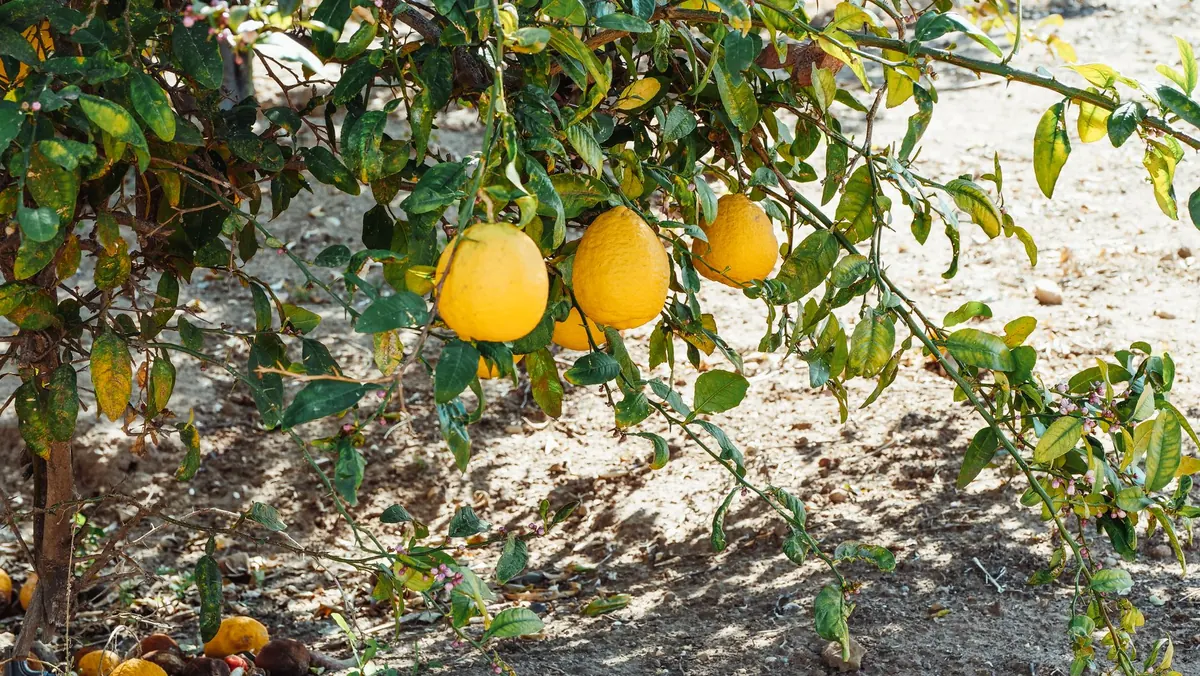
Not every yellow leaf is nutritional. Aphids, scale and whitefly feed on sap and excrete honeydew, which coats the leaves and feeds a black sooty mould. The result is a dull, sticky, yellowing canopy that looks like a nutrient problem until you look underneath the leaves or along the stems. Ants moving up and down the trunk are a useful clue: they farm scale and protect it from predators.
Check the undersides of leaves, the new growth and the joints where branches meet. A heavy scale infestation can be scraped off with a fingernail, while a light horticultural oil spray may smother the rest. A branch that has been girdled by a too-tight tie, a whipper-snipper or a weeding tool will yellow from the tip backward, because the damage cuts the flow of sap. Follow the yellowing back to its source and inspect the bark.
Cold, Wind and Root Disturbance
Cold snaps and cold winds can turn the newest leaves pale or bronzed, especially on young trees and tender varieties. The damage is often worst on the exposed side of the canopy and improves as the weather warms. Transplant shock works in a similar way: a newly moved tree loses roots in the process, so it cannot support all its leaves, and yellowing followed by leaf drop is a common response. Keep it watered, do not feed it hard, and give it a season to settle.
Root rot and physical root injury are harder to see but follow the same logic. A tree planted too deep, a tree whose roots were waterlogged for a week, or a tree damaged by digging nearby may yellow evenly and slowly. If the soil smells sour and the roots are dark rather than creamy, drainage is the first thing to fix.
Yellow leaves are a message from the roots, not a verdict on the fertiliser shelf.
What to Do Next: A Short Action Plan
- Inspect the pattern, the leaf age and the undersides of the leaves before making a diagnosis.
- Check soil moisture at root depth in several places, then water or drain as needed.
- Rule out pests, girdled branches and recent cold or root disturbance.
- Match any deficiency pattern to the correct nutrient before feeding.
- Test the soil if yellowing returns after a reasonable feeding programme.
- Change one thing at a time and wait two to three weeks before judging the result.
The eight causes worth ruling out are water imbalance, nitrogen, magnesium, iron, zinc or manganese, pests and girdling, cold or root disturbance, and soil pH or salinity. Most trees will declare their answer within a month of steady, sensible care — provided the gardener resists the urge to feed first and ask questions later.
Photo: Kindel Media / Pexels