From Orchard to Kitchen: 5 Small-Batch Orange Preserves to Make This Winter
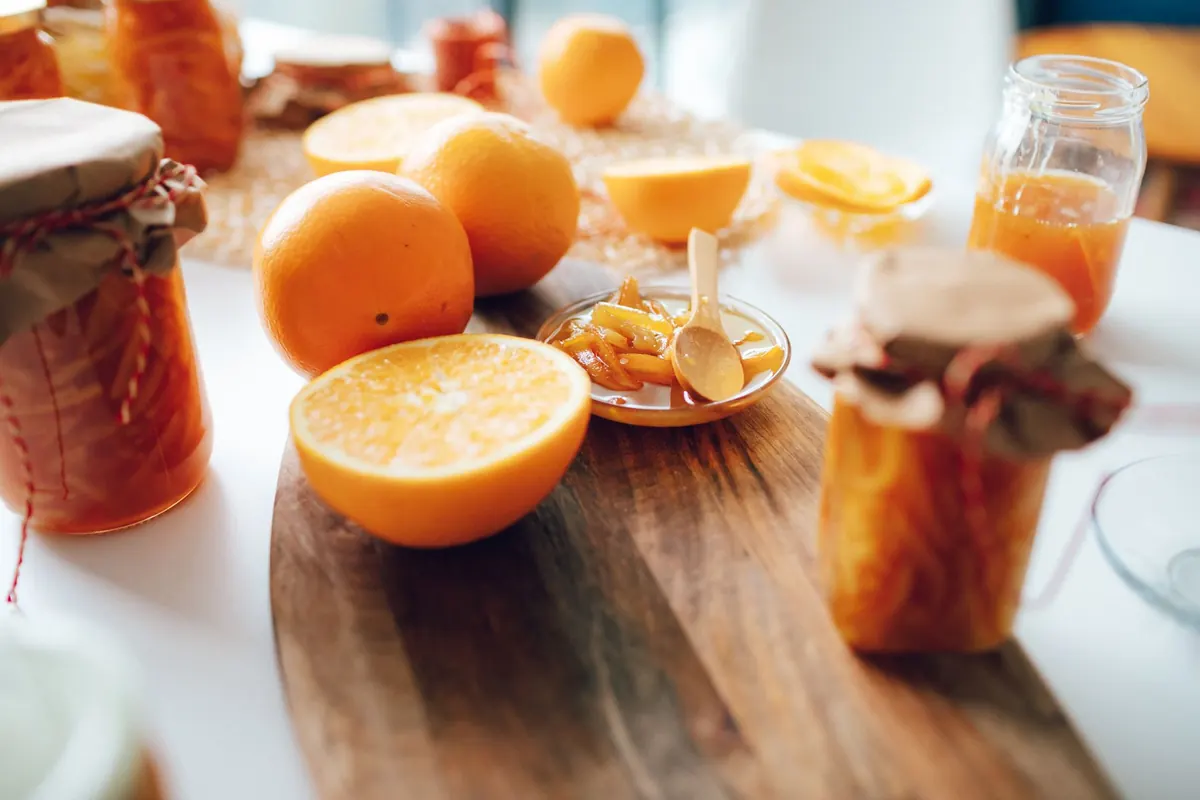
By mid-January the orchard has settled into its quiet season and the kitchen takes over. Crates of Tarocco and Moro come in from the cold, some with skins marked by wind, and the question is never what to do with four oranges but what to do with forty. Preserving is the answer that keeps giving: a few hours at the stove, a dozen jars cooling on a towel, and the smell of bitter peel in the house until evening. These five small-batch preserves are the ones worth repeating every winter — a marmalade that bites back, a soft-set jam, a curd, a jelly, and a jar of candied peel. Each makes between three and eight jars, which is the right scale for a home kitchen: enough to see you through to spring, not so much that you stop paying attention.
Choosing Oranges Worth Preserving
Preserves are only as good as the fruit that goes in, and oranges are not interchangeable. For marmalade you want bitter oranges — the Seville type, arancia amara or melangolo — high in pectin and in the aromatic bitterness that survives sugar. They show up for a short window around January; if you cannot find them, a sweet-orange marmalade with a generous share of lemon peel is a decent second best. For curd, jelly and quick jams, choose thin-skinned, heavy, juicy fruit: Tarocco, Moro and Sanguinello for colour, Navelina or Ovale for volume of juice.
Pick fruit that feels heavy for its size and firm at the navel, with no soft patches. A few marks on the skin mean nothing once it is cut; mould does. If you plan to use the peel — and in these recipes you nearly always do — buy organic or unwaxed oranges, or scrub waxed fruit under hot water with a little bicarbonate of soda and rinse well. Expect roughly half the fruit's weight in juice from a juicy variety; bitter oranges give a little less and a good deal more pectin.
Jars, Pans and the Rules That Matter
Most home preserving goes wrong at the jar, not at the recipe. Wash jars and lids in hot soapy water, rinse, then sterilise: stand them upside down in a 120°C oven for 15 minutes, or boil for 10 minutes and dry on a clean cloth. Fill jars while both preserve and jar are hot, leave about 5 mm of headspace, wipe the rim with a damp cloth and seal.
For jars you want to keep in a cupboard, process them in a water bath — covered by 2–3 cm of water, boiled for 10–15 minutes depending on jar size — then leave undisturbed for 24 hours and check that every lid has pulled down. Anything that has not sealed goes into the fridge and gets eaten first. If you would rather skip the water bath, make refrigerator preserves and use them within three weeks. If you are new to canning, follow a tested source for processing times at your altitude and jar size before you improvise.
A short list of what genuinely helps:
- A wide, heavy-based pan. Jam climbs fast in a tall narrow one.
- A jam thermometer, or a saucer kept in the freezer for testing set.
- Muslin or clean cotton cloth for pips and membranes, where much of the pectin sits.
- Jars of 200–300 ml: they set faster and open fresher.
- Lemon juice. Oranges are less acidic than they taste, and a little acid helps both set and colour.
Two more rules. Do not cut the sugar drastically in a water-bath recipe, because sugar is part of what keeps the jar safe. And write the date on every label while the pan is still warm and you still remember what you did.
The Five Preserves
1. Seville Orange Marmalade
Makes about 6 jars of 300 ml. 1 kg bitter oranges, 2 lemons, 1.75 kg preserving sugar, 2.5 litres water. Scrub the fruit, halve and squeeze the juice into a bowl. Scoop pips and membranes into a muslin square and tie it. Shred the peel as thick or fine as you like — 2 mm is a good middle ground — and put it in the pan with the juice, water and muslin bag. Simmer gently for 1.5–2 hours, until a shred crushes easily between your fingers. Lift out the bag, squeezing it back into the pan, then add the sugar and stir over low heat until it has dissolved completely. Raise the heat and boil hard to setting point: 105°C, or a teaspoon on a chilled saucer that wrinkles when you push it. Skim the foam, rest for 10 minutes so the shreds stay suspended, then pot, seal and process for 10 minutes.
Good marmalade is not sweet. It is sweet enough — the bitterness is the point.
2. Blood Orange and Vanilla Refrigerator Jam
Makes 4 jars; keep refrigerated. 1 kg blood oranges, 400 g sugar, juice of 1 lemon, 1 vanilla pod. Slice the oranges thinly, remove the pips and macerate with the sugar and split vanilla pod overnight. Next day cook over medium heat for 25–35 minutes, stirring, until the syrup thickens and a drop holds its shape on a cold plate; add the lemon juice in the last five minutes. Blood oranges fade with long cooking, so keep the heat moderate and stop as soon as the set looks right. Pot hot, cool, and refrigerate for up to three weeks, or water-bath for 10 minutes for shelf-stable jars.
3. Orange Curd
Makes 3 small jars; refrigerated. 120 ml strained orange juice, zest of 2 oranges and 1 lemon, 120 g sugar, 3 egg yolks plus 1 whole egg, 80 g cold butter in cubes. Whisk everything except the butter in a heatproof bowl over barely simmering water, stirring constantly for 10–12 minutes, until it thickens to the texture of lightly whipped cream and reaches about 82°C. Do not let it boil. Off the heat, whisk in the butter a cube at a time, strain if you want it silk-smooth, pot and chill. Use within three weeks; curd does not survive a water bath. Use fresh eggs, keep the jars cold, and if you are cooking for anyone pregnant, elderly or immunocompromised, take proper advice on egg-based preserves.
4. Orange and Rosemary Jelly
Makes 4 jars. 1 litre freshly squeezed orange juice, 1 kg preserving sugar with pectin, a sprig of rosemary, 2 tbsp lemon juice. Warm the juice with the rosemary and lemon until steaming but not boiling, then infuse off the heat for 20 minutes. Remove the rosemary, add the sugar, dissolve over low heat and boil hard for 5–8 minutes, testing for set. Pour through a fine sieve into hot jars if you want it clear, seal and process for 10 minutes. Plain orange juice has little pectin of its own, so the preserving sugar is doing the work; follow its ratio rather than improvising.
5. Candied Orange Peel in Syrup
Makes 2 jars. Peel from 6 thick-skinned oranges cut into strips, 500 g sugar, 500 ml water. Blanch the peel three times — cover with cold water, bring to the boil, drain, repeat — which pulls out the harshest bitterness and leaves the perfume. Simmer the peel in the sugar and water for 45–60 minutes, until translucent and glossy
Photo: ROMAN ODINTSOV / Pexels